The aeration of the ice cream
The limitations of the price per litre
Tribune

Whether you are a simple consumer at the supermarket or in discussion with your supplier, it is highly likely that ice cream is quantified in litres. Although this is now the commercial standard, this method of quantification presents problems that we will explain here.
Understanding overrun: weight, air and the true cost of ice cream
A crucial concept in the world of ice cream is overrun. Overrun is the air incorporated naturally (during the crystallisation process) or artificially (being injected by pumps) into the ice cream during manufacturing. This overrun is a parameter used by manufacturers to influence the texture, the taste, but also the manufacturing cost of the ice cream. An ice cream will therefore naturally contain more or less air depending on the recipe, the equipment used and the manufacturing techniques. And logically, the more air there is, the less solid matter there will be in the ice cream.
Let us put aside the impact on taste and texture, which are mostly subjective concepts, to focus on the density of the ice cream. An ice cream with low overrun will be heavier (as it is filled with more matter and less air) than an ice cream with high overrun.
We can therefore observe a weight that differs depending on the ice cream (for the same volume and the same flavour) which will give us an initial indication of the overrun rate. And weight remains the most objective criterion for comparing the quantity of ice cream we buy. This is also why it is mandatory to state the weight of the ice cream, but also not to sell an ice cream weighing less than 450 grams per litre. And to go further, only the weight is mandatory for ice cream labelling, not the volume or quantity in litres...
Because indeed, as you can imagine, air is free, and so it is the search for increased profitability that will push some manufacturers to abuse overrun.
How light ice cream distorts the number of scoops served
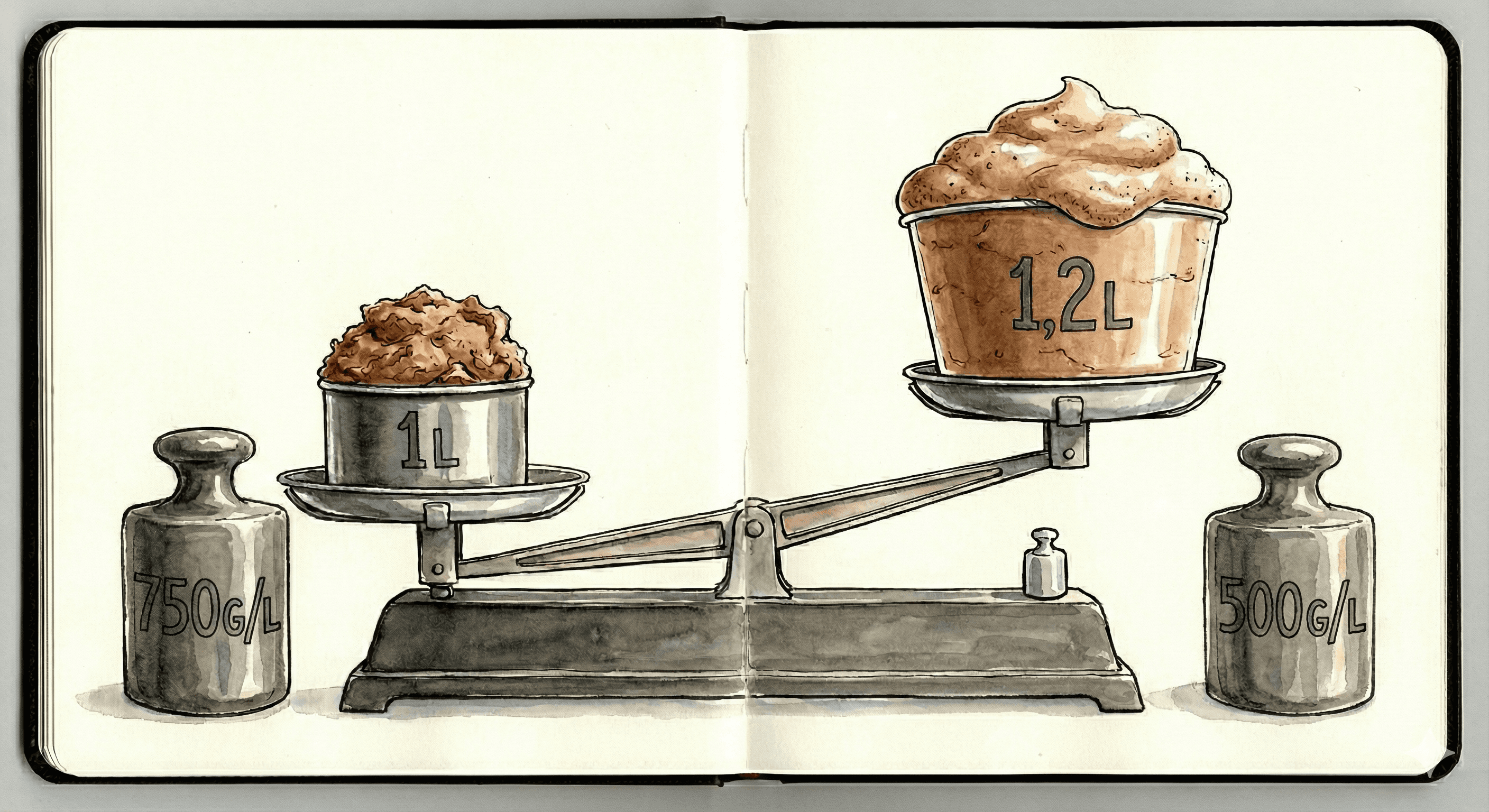
A common misconception among ice cream retailers is to think that the density of an ice cream or sorbet has no impact on the number of scoops that can be served from a litre. However, this is incorrect. An ice cream with a lot of overrun is a bit like a chocolate mousse or a soufflé: it seems to fill the tub well, but in reality, it contains mostly air. As soon as you dip a scoop into it, the matter compresses, the air escapes... and the volume collapses. As a result, you serve far fewer scoops than the apparent volume would lead you to believe. And that is not all: the more aerated an ice cream is, the faster it melts once served - air is not a very good insulator.
Visual effect of overflowing: the illusion of volume in tubs
Another factor that distorts the perception of the real quantity of ice cream sold is the way the tub is presented. Highly aerated ice creams are often displayed with a significant overflow above the tub, to visually accentuate the volume and give an impression of generosity. This spectacular presentation prevents any precise measurement of the actual volume contained beyond the tub. One can only estimate this additional "filling", and these estimates are often inflated, sometimes intentionally by certain manufacturers. The total advertised volume (sometimes 6, 6.5 or even 7 litres for a 5-litre tub) is therefore overestimated, which allows a lower cost per litre to be artificially displayed.
These various elements—high aeration, generous overflows, and reduced weight—have a direct impact on the actual profitability for the distributor. Because in the end, what matters is the number of scoops that can be served. However, this data is rarely calculated. Ideally, ice cream distributors should think in terms of cost per scoop, rather than cost per litre. But this approach remains difficult to implement as it requires testing and an analytical rigour that is complex to put in place. Otherwise, the cost per kilogramme remains the best indicator today for objectively comparing the density and real value of an ice cream.

B2C
Glacier Artisanal, Fabrication authentique… Ces mots ne veulent plus rien dire
(et c'est une bonne nouvelle)

B2C
Gelato ou glace artisanale : quelle est la vraie différence?
Les trois variables techniques qui séparent les deux catégories
B2C
How to choose and pair your ice cream flavours
The key principles for creating successful combinations
The aeration of the ice cream
The limitations of the price per litre
Tribune
Whether you are a simple consumer at the supermarket or in discussion with your supplier, it is highly likely that ice cream is quantified in litres. Although this is now the commercial standard, this method of quantification presents problems that we will explain here.
Understanding overrun: weight, air and the true cost of ice cream
A crucial concept in the world of ice cream is overrun. Overrun is the air incorporated naturally (during the crystallisation process) or artificially (being injected by pumps) into the ice cream during manufacturing. This overrun is a parameter used by manufacturers to influence the texture, the taste, but also the manufacturing cost of the ice cream. An ice cream will therefore naturally contain more or less air depending on the recipe, the equipment used and the manufacturing techniques. And logically, the more air there is, the less solid matter there will be in the ice cream.
Let us put aside the impact on taste and texture, which are mostly subjective concepts, to focus on the density of the ice cream. An ice cream with low overrun will be heavier (as it is filled with more matter and less air) than an ice cream with high overrun.
We can therefore observe a weight that differs depending on the ice cream (for the same volume and the same flavour) which will give us an initial indication of the overrun rate. And weight remains the most objective criterion for comparing the quantity of ice cream we buy. This is also why it is mandatory to state the weight of the ice cream, but also not to sell an ice cream weighing less than 450 grams per litre. And to go further, only the weight is mandatory for ice cream labelling, not the volume or quantity in litres...
Because indeed, as you can imagine, air is free, and so it is the search for increased profitability that will push some manufacturers to abuse overrun.
How light ice cream distorts the number of scoops served
A common misconception among ice cream retailers is to think that the density of an ice cream or sorbet has no impact on the number of scoops that can be served from a litre. However, this is incorrect. An ice cream with a lot of overrun is a bit like a chocolate mousse or a soufflé: it seems to fill the tub well, but in reality, it contains mostly air. As soon as you dip a scoop into it, the matter compresses, the air escapes... and the volume collapses. As a result, you serve far fewer scoops than the apparent volume would lead you to believe. And that is not all: the more aerated an ice cream is, the faster it melts once served - air is not a very good insulator.
Visual effect of overflowing: the illusion of volume in tubs
Another factor that distorts the perception of the real quantity of ice cream sold is the way the tub is presented. Highly aerated ice creams are often displayed with a significant overflow above the tub, to visually accentuate the volume and give an impression of generosity. This spectacular presentation prevents any precise measurement of the actual volume contained beyond the tub. One can only estimate this additional "filling", and these estimates are often inflated, sometimes intentionally by certain manufacturers. The total advertised volume (sometimes 6, 6.5 or even 7 litres for a 5-litre tub) is therefore overestimated, which allows a lower cost per litre to be artificially displayed.
These various elements—high aeration, generous overflows, and reduced weight—have a direct impact on the actual profitability for the distributor. Because in the end, what matters is the number of scoops that can be served. However, this data is rarely calculated. Ideally, ice cream distributors should think in terms of cost per scoop, rather than cost per litre. But this approach remains difficult to implement as it requires testing and an analytical rigour that is complex to put in place. Otherwise, the cost per kilogramme remains the best indicator today for objectively comparing the density and real value of an ice cream.
B2C
Glacier Artisanal, Fabrication authentique… Ces mots ne veulent plus rien dire
(et c'est une bonne nouvelle)
B2C
Gelato ou glace artisanale : quelle est la vraie différence?
Les trois variables techniques qui séparent les deux catégories
B2C
How to choose and pair your ice cream flavours
The key principles for creating successful combinations
The aeration of the ice cream
The limitations of the price per litre
Tribune
Whether you are a simple consumer at the supermarket or in discussion with your supplier, it is highly likely that ice cream is quantified in litres. Although this is now the commercial standard, this method of quantification presents problems that we will explain here.
Understanding overrun: weight, air and the true cost of ice cream
A crucial concept in the world of ice cream is overrun. Overrun is the air incorporated naturally (during the crystallisation process) or artificially (being injected by pumps) into the ice cream during manufacturing. This overrun is a parameter used by manufacturers to influence the texture, the taste, but also the manufacturing cost of the ice cream. An ice cream will therefore naturally contain more or less air depending on the recipe, the equipment used and the manufacturing techniques. And logically, the more air there is, the less solid matter there will be in the ice cream.
Let us put aside the impact on taste and texture, which are mostly subjective concepts, to focus on the density of the ice cream. An ice cream with low overrun will be heavier (as it is filled with more matter and less air) than an ice cream with high overrun.
We can therefore observe a weight that differs depending on the ice cream (for the same volume and the same flavour) which will give us an initial indication of the overrun rate. And weight remains the most objective criterion for comparing the quantity of ice cream we buy. This is also why it is mandatory to state the weight of the ice cream, but also not to sell an ice cream weighing less than 450 grams per litre. And to go further, only the weight is mandatory for ice cream labelling, not the volume or quantity in litres...
Because indeed, as you can imagine, air is free, and so it is the search for increased profitability that will push some manufacturers to abuse overrun.
How light ice cream distorts the number of scoops served
A common misconception among ice cream retailers is to think that the density of an ice cream or sorbet has no impact on the number of scoops that can be served from a litre. However, this is incorrect. An ice cream with a lot of overrun is a bit like a chocolate mousse or a soufflé: it seems to fill the tub well, but in reality, it contains mostly air. As soon as you dip a scoop into it, the matter compresses, the air escapes... and the volume collapses. As a result, you serve far fewer scoops than the apparent volume would lead you to believe. And that is not all: the more aerated an ice cream is, the faster it melts once served - air is not a very good insulator.
Visual effect of overflowing: the illusion of volume in tubs
Another factor that distorts the perception of the real quantity of ice cream sold is the way the tub is presented. Highly aerated ice creams are often displayed with a significant overflow above the tub, to visually accentuate the volume and give an impression of generosity. This spectacular presentation prevents any precise measurement of the actual volume contained beyond the tub. One can only estimate this additional "filling", and these estimates are often inflated, sometimes intentionally by certain manufacturers. The total advertised volume (sometimes 6, 6.5 or even 7 litres for a 5-litre tub) is therefore overestimated, which allows a lower cost per litre to be artificially displayed.
These various elements—high aeration, generous overflows, and reduced weight—have a direct impact on the actual profitability for the distributor. Because in the end, what matters is the number of scoops that can be served. However, this data is rarely calculated. Ideally, ice cream distributors should think in terms of cost per scoop, rather than cost per litre. But this approach remains difficult to implement as it requires testing and an analytical rigour that is complex to put in place. Otherwise, the cost per kilogramme remains the best indicator today for objectively comparing the density and real value of an ice cream.
B2C
Glacier Artisanal, Fabrication authentique… Ces mots ne veulent plus rien dire
(et c'est une bonne nouvelle)
B2C
Gelato ou glace artisanale : quelle est la vraie différence?
Les trois variables techniques qui séparent les deux catégories
B2C
How to choose and pair your ice cream flavours
The key principles for creating successful combinations

Maison Terme
Manufacturer and supplier of premium artisan ice creams for 20 years in Occitanie
Copyright © Maison Terme 2025
Maison Terme
Manufacturer and supplier of premium artisan ice creams for 20 years in Occitanie
Copyright © Maison Terme 2025
Maison Terme
Manufacturer and supplier of premium artisan ice creams for 20 years in Occitanie
Copyright © Maison Terme 2025