How to choose and pair your ice cream flavours
The key principles for creating successful combinations
Tribune
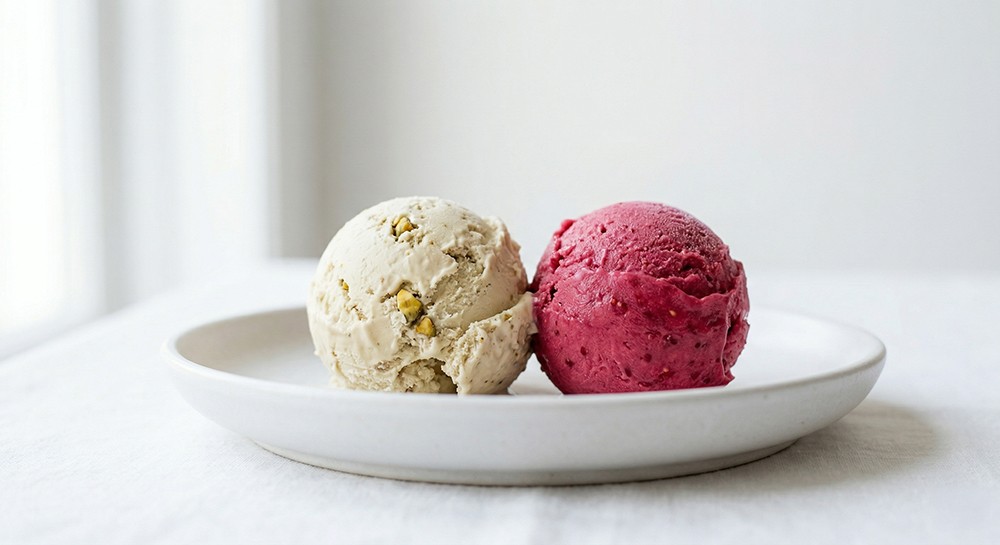
How to choose and pair your ice cream flavours perfectly
Have you ever had this experience? You spot two flavours you love in an ice cream shop, for example coffee and mango, and you think they will taste amazing together. You get a scoop of each. And then... it is disappointing. It is not bad, but it is not what you had imagined.
Why? Because you chose two flavours you love individually, without thinking about how they would interact on the palate.
And that is the key point. When you eat an ice cream with two flavours, the ice cream melts. The scoops mix. The flavours do not stay separate: they blend. If you have not considered this interaction when choosing, you end up with a combination that does not work, even if each flavour on its own was excellent.
It is not a matter of personal preference. It is a matter of technique: understanding how flavours behave when they blend together.
And the good news? This can be learnt. There are some quite simple principles to help you create great pairings. There is no need to be a pastry chef. You simply need to understand how flavours complement one another.
Our three guiding principles for a successful pairing
The hierarchy of flavours
Imagine putting two very strong personalities in the same room and leaving them alone. They will clash. Each tries to impose their view, each wants to be heard, and in the end, no one is listening.
This is exactly what happens when two flavours of equal intensity meet.
The approach that works is to establish a hierarchy. One lead flavour that you can really taste, which takes centre stage. And another accompanying flavour that supports it, bringing something extra without trying to dominate.
Example: strawberry and basil. The strawberry is clearly the main focus. You have strawberry ice cream. The basil is the guest that comes to enrich the strawberry, making it livelier and more interesting. You immediately understand that it is strawberry enhanced with something fresh.
This is even more important as the ice cream melts. The flavours intensify and become more concentrated. If two flavours had the same strength, you would end up with a muddy mix where nothing is distinct.
The crucial rule of complex flavours
This is probably the most important point of all.
There are simple flavours: vanilla, chocolate, strawberry. Just one taste sensation.
And there are complex flavours: lemon, mint and basil, for example. These are several flavours coexisting in the same ice cream, blending to create something more nuanced and sophisticated.
Here is the rule: if you choose a complex flavour, pair it with a simple flavour.
Why? Because putting two complex flavours together dilutes all the subtleties. It is like having five interesting conversations going on at the same time in the same room: in the end, you cannot hear anything. Just noise.
But pairing a complex flavour with a simple one creates harmony. The simple flavour leaves room for the complex one. It accompanies it without trying to take over. The result is balance.
Example: lemon, mint and basil (complex) plus vanilla (simple). This works. You can taste the nuances of the lemon, mint and basil, while the vanilla subtly supports them.
Counter-example: lemon, mint and basil plus strawberry and honey. Strawberry and honey is also complex. The strawberry, the honey, their interaction. The result? You cannot taste anything clearly. It is just a muddle.
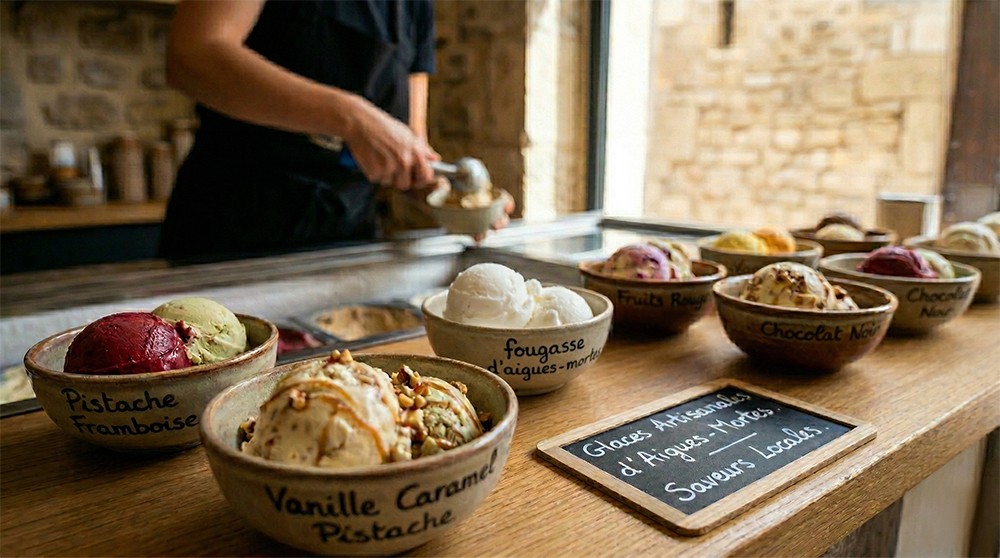
Flavour families: learning to explore them
For more complex combinations involving, for example, three different flavours, you can rely on flavour families. To pair flavours successfully, it helps to group them mentally by family. They are like familiar groups where you know who gets along with whom. For a balanced combination in a 3-scoop ice cream, we advise pairing two flavours from the same family with a third from a different family.
Red fruits: Strawberry, cherry, blackberry, blackcurrant. These are sweet flavours with a slight acidity. They get along very well together.
Exotic fruits: Mango, pineapple, passion fruit, banana. These are sweeter and more intense. Together, they create a rich, delicious combination.
Chocolate and cocoa: This is a family of its own. Dark chocolate is bitter and deep, whilst milk chocolate is sweeter. It is a complete flavour in its own right.
Nuts: Hazelnut, pistachio, walnut, almond. These are warm, toasted flavours. They bring depth and contrast.
Indulgence: Caramel, honey, vanilla. These are comforting flavours. They pair nicely with almost anything.
Herbal flavours: Mint, basil, tea, lavender. These are fresh and sophisticated flavours. They wake up the palate and pique interest.
Spices and citrus: Lemon, ginger, cinnamon, orange. These are lively flavours. The acidity of lemon, the warmth of ginger, the sweetness of orange. They bring a touch of energy.
How does it work? Flavours from the same family tend to complement each other naturally. You can mix two red fruits without any risk. However, when you mix different families, that is when you create contrast. Lemon (spices and citrus) plus basil (herbal) is an interesting contrast because there is a clear logic behind it.
What works: tried and tested combinations
Let us look at a few classic, proven combinations to better understand the approach.
Pistachio and raspberry
This is a subtle and sophisticated pairing. The pistachio brings a toasted warmth, while the raspberry brings a light acidity. They complement each other without competing. The pistachio dominates, whilst the raspberry gently adds contrast. This is a pairing that has been used in patisserie for a long time because it truly works.
Vanilla and caramel
This is the ultimate complementary pairing. Two flavours that speak the same language: sweetness. But vanilla is light and gentle, whilst caramel is sweet and rich. Together, they create a balanced, delicious feeling. It is a timeless classic that works every single time.
Mango and coconut
Two exotic fruits that understand each other well. Mango brings acidity and a fruity aroma, while coconut brings a creamy sweetness. Together, they create a generous, holiday-like feeling. It is a pairing found everywhere because it has proven its worth.
What does not work: common pitfalls
There are combinations that seem logical on paper but fail on the palate. Understanding them helps you avoid disappointing surprises.
Two dominant flavours competing
Dark chocolate and strawberry is the best example. Both are intense, and both want to be the star. When they mix, they do not create an interesting contrast: they create confusion. The bitterness of the chocolate overpowers the acidity of the strawberry, or vice versa. The result on the palate is aggressive rather than harmonious.
Ice cream and sorbet: a tricky balance
This is a combination that can work, but it is delicate. Ice cream (dense, rich) and sorbet (light, fruity) have very different profiles. When they mix, the sorbet can be overwhelmed by the density of the ice cream, or on the contrary, the ice cream can seem heavy next to the sorbet. It really depends on the balance and the specific flavours. Approach with care.
Things to keep in mind when choosing
Think about what happens on the palate, not just each individual flavour on its own. You love dark chocolate. You love strawberry. But together? It presents a problem. Both are intense, dominant, and they do not complement each other: they compete. Dark chocolate is bitter and deep, whilst strawberry is tangy and lively. When they melt together, the result is confusing and overly aggressive. Test it if you like, but keep in mind that it is not just two flavours sitting side by side. It is a fusion that can become chaotic.
Look for complementarity OR contrast, not chaos. Either two flavours that reinforce each other (complementarity), or two flavours that create an interesting dialogue (contrast). But not two flavours that compete for no reason.
One dominant flavour, one supporting flavour. Do not put two flavours of equal intensity side by side. As the ice cream melts, they will both intensify and create a blurred taste. One should guide, the other should support.
Respect the rule of complex flavours. If you choose a complex flavour (with 3 or more blended ingredients), pair it with a simple flavour. Otherwise, you dilute all the subtleties.
Look for connections. Search for small, logical connections between two distant flavours. Lemon plus honey: linked by the idea of "comforting sweetness". Chocolate plus chilli: the chilli wakes up the chocolate.
Do not overload with too many different flavours. Leonardo da Vinci said that "Simplicity is the ultimate sophistication".
To finish
You now have the principles to help you think about ice cream combinations.
But above all, you have the tools to explore. To create your own combinations without hesitation. To taste, make mistakes, and try again.
Because ultimately, eating ice cream is not just about consuming something cold and sweet. It is about creating an experience. And when you learn to pair flavours well, you enhance this experience exponentially.
So go ahead. Test them out. Listen to your instincts. And above all, enjoy it.

B2C
Glacier Artisanal, Fabrication authentique… Ces mots ne veulent plus rien dire
(et c'est une bonne nouvelle)
B2C
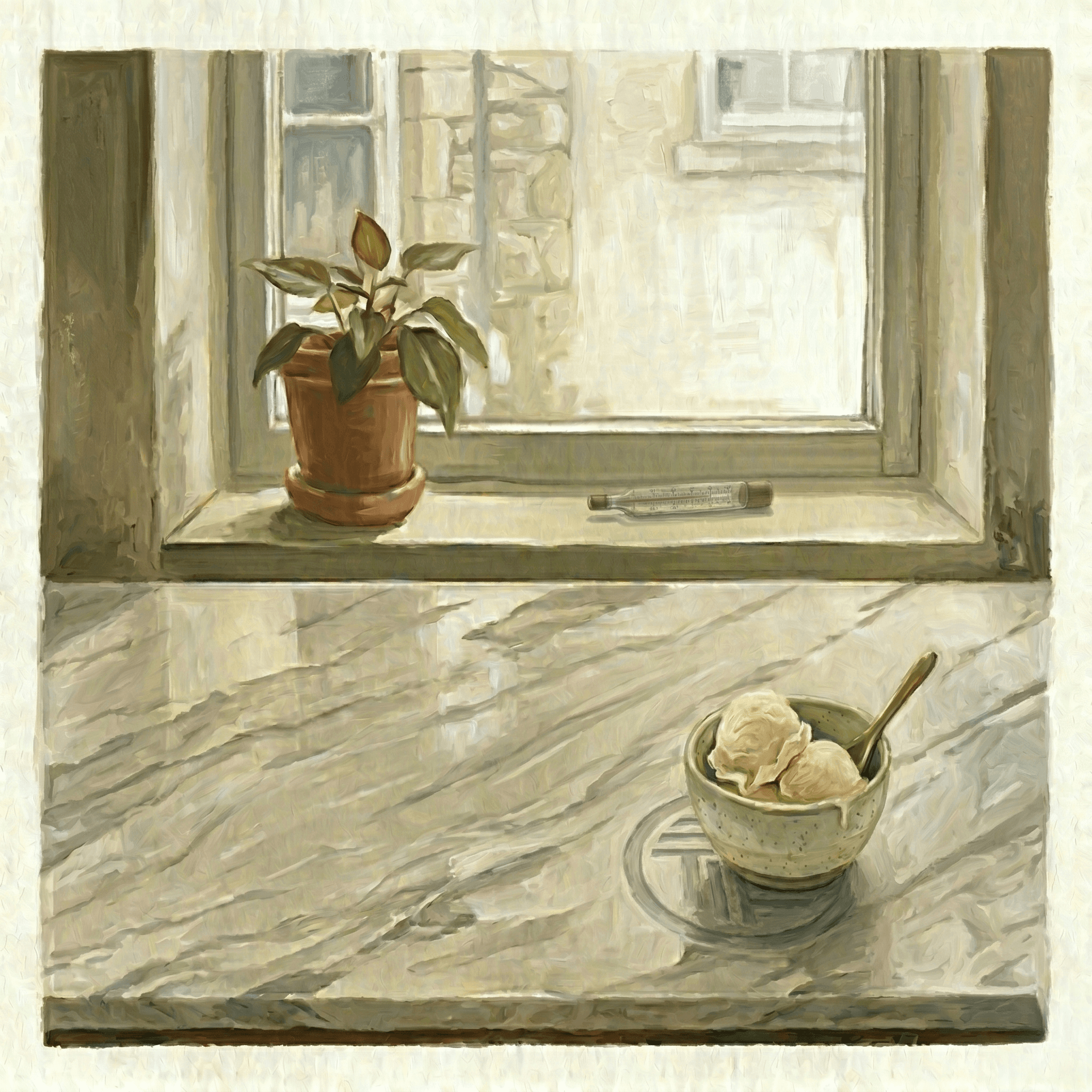
Gelato ou glace artisanale : quelle est la vraie différence?
Les trois variables techniques qui séparent les deux catégories
B2B
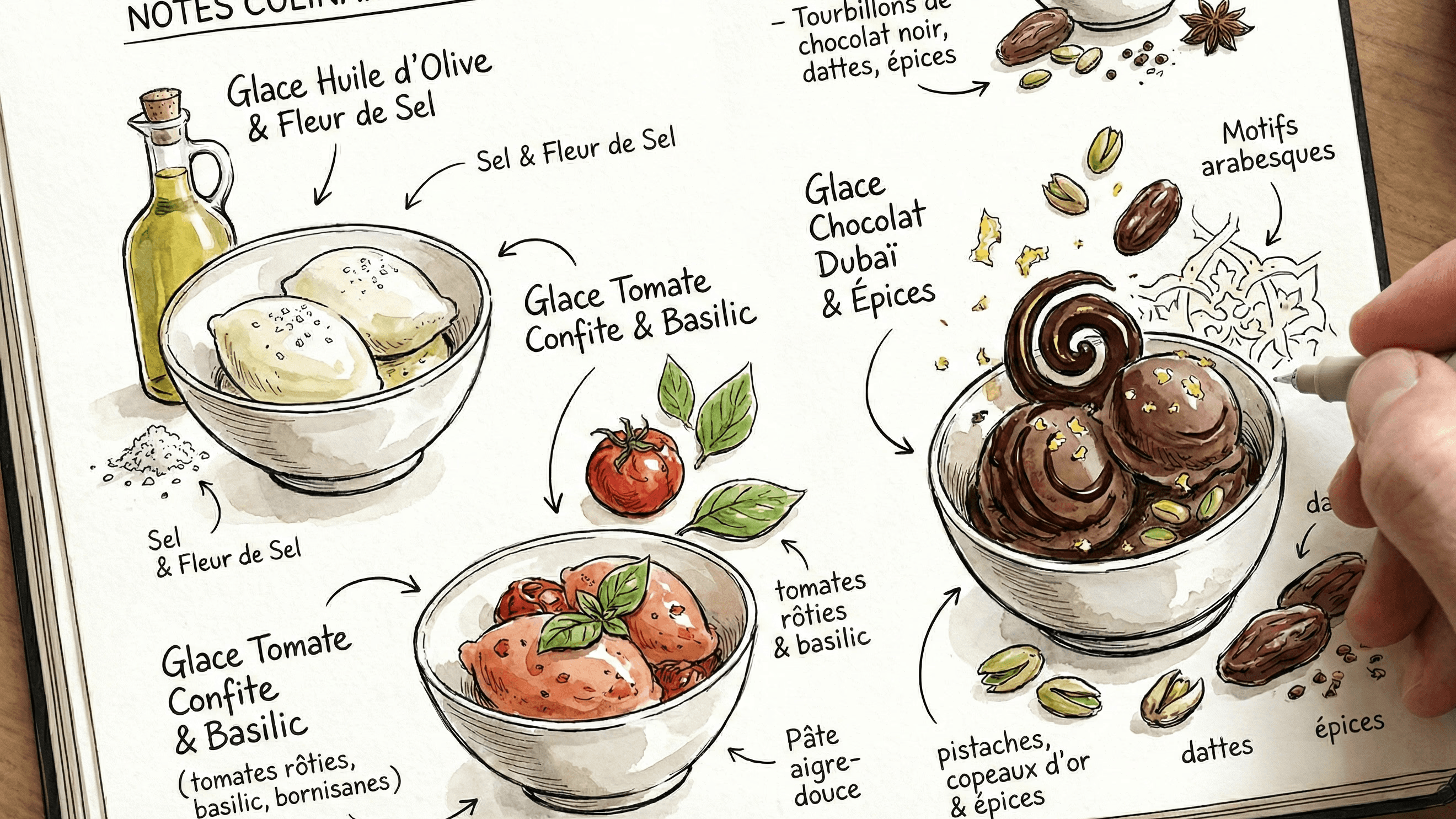
New trends in ice cream: a controlled return to basics
A look at contemporary developments in ice cream, encompassing a shift towards simpler ingredients, more adult flavours, refined pairings, the emergence of savoury ice creams, and greater responsiveness to brief trends driven by social media.
How to choose and pair your ice cream flavours
The key principles for creating successful combinations
Tribune
How to choose and pair your ice cream flavours perfectly
Have you ever had this experience? You spot two flavours you love in an ice cream shop, for example coffee and mango, and you think they will taste amazing together. You get a scoop of each. And then... it is disappointing. It is not bad, but it is not what you had imagined.
Why? Because you chose two flavours you love individually, without thinking about how they would interact on the palate.
And that is the key point. When you eat an ice cream with two flavours, the ice cream melts. The scoops mix. The flavours do not stay separate: they blend. If you have not considered this interaction when choosing, you end up with a combination that does not work, even if each flavour on its own was excellent.
It is not a matter of personal preference. It is a matter of technique: understanding how flavours behave when they blend together.
And the good news? This can be learnt. There are some quite simple principles to help you create great pairings. There is no need to be a pastry chef. You simply need to understand how flavours complement one another.
Our three guiding principles for a successful pairing
The hierarchy of flavours
Imagine putting two very strong personalities in the same room and leaving them alone. They will clash. Each tries to impose their view, each wants to be heard, and in the end, no one is listening.
This is exactly what happens when two flavours of equal intensity meet.
The approach that works is to establish a hierarchy. One lead flavour that you can really taste, which takes centre stage. And another accompanying flavour that supports it, bringing something extra without trying to dominate.
Example: strawberry and basil. The strawberry is clearly the main focus. You have strawberry ice cream. The basil is the guest that comes to enrich the strawberry, making it livelier and more interesting. You immediately understand that it is strawberry enhanced with something fresh.
This is even more important as the ice cream melts. The flavours intensify and become more concentrated. If two flavours had the same strength, you would end up with a muddy mix where nothing is distinct.
The crucial rule of complex flavours
This is probably the most important point of all.
There are simple flavours: vanilla, chocolate, strawberry. Just one taste sensation.
And there are complex flavours: lemon, mint and basil, for example. These are several flavours coexisting in the same ice cream, blending to create something more nuanced and sophisticated.
Here is the rule: if you choose a complex flavour, pair it with a simple flavour.
Why? Because putting two complex flavours together dilutes all the subtleties. It is like having five interesting conversations going on at the same time in the same room: in the end, you cannot hear anything. Just noise.
But pairing a complex flavour with a simple one creates harmony. The simple flavour leaves room for the complex one. It accompanies it without trying to take over. The result is balance.
Example: lemon, mint and basil (complex) plus vanilla (simple). This works. You can taste the nuances of the lemon, mint and basil, while the vanilla subtly supports them.
Counter-example: lemon, mint and basil plus strawberry and honey. Strawberry and honey is also complex. The strawberry, the honey, their interaction. The result? You cannot taste anything clearly. It is just a muddle.
Flavour families: learning to explore them
For more complex combinations involving, for example, three different flavours, you can rely on flavour families. To pair flavours successfully, it helps to group them mentally by family. They are like familiar groups where you know who gets along with whom. For a balanced combination in a 3-scoop ice cream, we advise pairing two flavours from the same family with a third from a different family.
Red fruits: Strawberry, cherry, blackberry, blackcurrant. These are sweet flavours with a slight acidity. They get along very well together.
Exotic fruits: Mango, pineapple, passion fruit, banana. These are sweeter and more intense. Together, they create a rich, delicious combination.
Chocolate and cocoa: This is a family of its own. Dark chocolate is bitter and deep, whilst milk chocolate is sweeter. It is a complete flavour in its own right.
Nuts: Hazelnut, pistachio, walnut, almond. These are warm, toasted flavours. They bring depth and contrast.
Indulgence: Caramel, honey, vanilla. These are comforting flavours. They pair nicely with almost anything.
Herbal flavours: Mint, basil, tea, lavender. These are fresh and sophisticated flavours. They wake up the palate and pique interest.
Spices and citrus: Lemon, ginger, cinnamon, orange. These are lively flavours. The acidity of lemon, the warmth of ginger, the sweetness of orange. They bring a touch of energy.
How does it work? Flavours from the same family tend to complement each other naturally. You can mix two red fruits without any risk. However, when you mix different families, that is when you create contrast. Lemon (spices and citrus) plus basil (herbal) is an interesting contrast because there is a clear logic behind it.
What works: tried and tested combinations
Let us look at a few classic, proven combinations to better understand the approach.
Pistachio and raspberry
This is a subtle and sophisticated pairing. The pistachio brings a toasted warmth, while the raspberry brings a light acidity. They complement each other without competing. The pistachio dominates, whilst the raspberry gently adds contrast. This is a pairing that has been used in patisserie for a long time because it truly works.
Vanilla and caramel
This is the ultimate complementary pairing. Two flavours that speak the same language: sweetness. But vanilla is light and gentle, whilst caramel is sweet and rich. Together, they create a balanced, delicious feeling. It is a timeless classic that works every single time.
Mango and coconut
Two exotic fruits that understand each other well. Mango brings acidity and a fruity aroma, while coconut brings a creamy sweetness. Together, they create a generous, holiday-like feeling. It is a pairing found everywhere because it has proven its worth.
What does not work: common pitfalls
There are combinations that seem logical on paper but fail on the palate. Understanding them helps you avoid disappointing surprises.
Two dominant flavours competing
Dark chocolate and strawberry is the best example. Both are intense, and both want to be the star. When they mix, they do not create an interesting contrast: they create confusion. The bitterness of the chocolate overpowers the acidity of the strawberry, or vice versa. The result on the palate is aggressive rather than harmonious.
Ice cream and sorbet: a tricky balance
This is a combination that can work, but it is delicate. Ice cream (dense, rich) and sorbet (light, fruity) have very different profiles. When they mix, the sorbet can be overwhelmed by the density of the ice cream, or on the contrary, the ice cream can seem heavy next to the sorbet. It really depends on the balance and the specific flavours. Approach with care.
Things to keep in mind when choosing
Think about what happens on the palate, not just each individual flavour on its own. You love dark chocolate. You love strawberry. But together? It presents a problem. Both are intense, dominant, and they do not complement each other: they compete. Dark chocolate is bitter and deep, whilst strawberry is tangy and lively. When they melt together, the result is confusing and overly aggressive. Test it if you like, but keep in mind that it is not just two flavours sitting side by side. It is a fusion that can become chaotic.
Look for complementarity OR contrast, not chaos. Either two flavours that reinforce each other (complementarity), or two flavours that create an interesting dialogue (contrast). But not two flavours that compete for no reason.
One dominant flavour, one supporting flavour. Do not put two flavours of equal intensity side by side. As the ice cream melts, they will both intensify and create a blurred taste. One should guide, the other should support.
Respect the rule of complex flavours. If you choose a complex flavour (with 3 or more blended ingredients), pair it with a simple flavour. Otherwise, you dilute all the subtleties.
Look for connections. Search for small, logical connections between two distant flavours. Lemon plus honey: linked by the idea of "comforting sweetness". Chocolate plus chilli: the chilli wakes up the chocolate.
Do not overload with too many different flavours. Leonardo da Vinci said that "Simplicity is the ultimate sophistication".
To finish
You now have the principles to help you think about ice cream combinations.
But above all, you have the tools to explore. To create your own combinations without hesitation. To taste, make mistakes, and try again.
Because ultimately, eating ice cream is not just about consuming something cold and sweet. It is about creating an experience. And when you learn to pair flavours well, you enhance this experience exponentially.
So go ahead. Test them out. Listen to your instincts. And above all, enjoy it.
B2C
Glacier Artisanal, Fabrication authentique… Ces mots ne veulent plus rien dire
(et c'est une bonne nouvelle)
B2C
Gelato ou glace artisanale : quelle est la vraie différence?
Les trois variables techniques qui séparent les deux catégories
B2B
New trends in ice cream: a controlled return to basics
A look at contemporary developments in ice cream, encompassing a shift towards simpler ingredients, more adult flavours, refined pairings, the emergence of savoury ice creams, and greater responsiveness to brief trends driven by social media.
How to choose and pair your ice cream flavours
The key principles for creating successful combinations
Tribune
How to choose and pair your ice cream flavours perfectly
Have you ever had this experience? You spot two flavours you love in an ice cream shop, for example coffee and mango, and you think they will taste amazing together. You get a scoop of each. And then... it is disappointing. It is not bad, but it is not what you had imagined.
Why? Because you chose two flavours you love individually, without thinking about how they would interact on the palate.
And that is the key point. When you eat an ice cream with two flavours, the ice cream melts. The scoops mix. The flavours do not stay separate: they blend. If you have not considered this interaction when choosing, you end up with a combination that does not work, even if each flavour on its own was excellent.
It is not a matter of personal preference. It is a matter of technique: understanding how flavours behave when they blend together.
And the good news? This can be learnt. There are some quite simple principles to help you create great pairings. There is no need to be a pastry chef. You simply need to understand how flavours complement one another.
Our three guiding principles for a successful pairing
The hierarchy of flavours
Imagine putting two very strong personalities in the same room and leaving them alone. They will clash. Each tries to impose their view, each wants to be heard, and in the end, no one is listening.
This is exactly what happens when two flavours of equal intensity meet.
The approach that works is to establish a hierarchy. One lead flavour that you can really taste, which takes centre stage. And another accompanying flavour that supports it, bringing something extra without trying to dominate.
Example: strawberry and basil. The strawberry is clearly the main focus. You have strawberry ice cream. The basil is the guest that comes to enrich the strawberry, making it livelier and more interesting. You immediately understand that it is strawberry enhanced with something fresh.
This is even more important as the ice cream melts. The flavours intensify and become more concentrated. If two flavours had the same strength, you would end up with a muddy mix where nothing is distinct.
The crucial rule of complex flavours
This is probably the most important point of all.
There are simple flavours: vanilla, chocolate, strawberry. Just one taste sensation.
And there are complex flavours: lemon, mint and basil, for example. These are several flavours coexisting in the same ice cream, blending to create something more nuanced and sophisticated.
Here is the rule: if you choose a complex flavour, pair it with a simple flavour.
Why? Because putting two complex flavours together dilutes all the subtleties. It is like having five interesting conversations going on at the same time in the same room: in the end, you cannot hear anything. Just noise.
But pairing a complex flavour with a simple one creates harmony. The simple flavour leaves room for the complex one. It accompanies it without trying to take over. The result is balance.
Example: lemon, mint and basil (complex) plus vanilla (simple). This works. You can taste the nuances of the lemon, mint and basil, while the vanilla subtly supports them.
Counter-example: lemon, mint and basil plus strawberry and honey. Strawberry and honey is also complex. The strawberry, the honey, their interaction. The result? You cannot taste anything clearly. It is just a muddle.
Flavour families: learning to explore them
For more complex combinations involving, for example, three different flavours, you can rely on flavour families. To pair flavours successfully, it helps to group them mentally by family. They are like familiar groups where you know who gets along with whom. For a balanced combination in a 3-scoop ice cream, we advise pairing two flavours from the same family with a third from a different family.
Red fruits: Strawberry, cherry, blackberry, blackcurrant. These are sweet flavours with a slight acidity. They get along very well together.
Exotic fruits: Mango, pineapple, passion fruit, banana. These are sweeter and more intense. Together, they create a rich, delicious combination.
Chocolate and cocoa: This is a family of its own. Dark chocolate is bitter and deep, whilst milk chocolate is sweeter. It is a complete flavour in its own right.
Nuts: Hazelnut, pistachio, walnut, almond. These are warm, toasted flavours. They bring depth and contrast.
Indulgence: Caramel, honey, vanilla. These are comforting flavours. They pair nicely with almost anything.
Herbal flavours: Mint, basil, tea, lavender. These are fresh and sophisticated flavours. They wake up the palate and pique interest.
Spices and citrus: Lemon, ginger, cinnamon, orange. These are lively flavours. The acidity of lemon, the warmth of ginger, the sweetness of orange. They bring a touch of energy.
How does it work? Flavours from the same family tend to complement each other naturally. You can mix two red fruits without any risk. However, when you mix different families, that is when you create contrast. Lemon (spices and citrus) plus basil (herbal) is an interesting contrast because there is a clear logic behind it.
What works: tried and tested combinations
Let us look at a few classic, proven combinations to better understand the approach.
Pistachio and raspberry
This is a subtle and sophisticated pairing. The pistachio brings a toasted warmth, while the raspberry brings a light acidity. They complement each other without competing. The pistachio dominates, whilst the raspberry gently adds contrast. This is a pairing that has been used in patisserie for a long time because it truly works.
Vanilla and caramel
This is the ultimate complementary pairing. Two flavours that speak the same language: sweetness. But vanilla is light and gentle, whilst caramel is sweet and rich. Together, they create a balanced, delicious feeling. It is a timeless classic that works every single time.
Mango and coconut
Two exotic fruits that understand each other well. Mango brings acidity and a fruity aroma, while coconut brings a creamy sweetness. Together, they create a generous, holiday-like feeling. It is a pairing found everywhere because it has proven its worth.
What does not work: common pitfalls
There are combinations that seem logical on paper but fail on the palate. Understanding them helps you avoid disappointing surprises.
Two dominant flavours competing
Dark chocolate and strawberry is the best example. Both are intense, and both want to be the star. When they mix, they do not create an interesting contrast: they create confusion. The bitterness of the chocolate overpowers the acidity of the strawberry, or vice versa. The result on the palate is aggressive rather than harmonious.
Ice cream and sorbet: a tricky balance
This is a combination that can work, but it is delicate. Ice cream (dense, rich) and sorbet (light, fruity) have very different profiles. When they mix, the sorbet can be overwhelmed by the density of the ice cream, or on the contrary, the ice cream can seem heavy next to the sorbet. It really depends on the balance and the specific flavours. Approach with care.
Things to keep in mind when choosing
Think about what happens on the palate, not just each individual flavour on its own. You love dark chocolate. You love strawberry. But together? It presents a problem. Both are intense, dominant, and they do not complement each other: they compete. Dark chocolate is bitter and deep, whilst strawberry is tangy and lively. When they melt together, the result is confusing and overly aggressive. Test it if you like, but keep in mind that it is not just two flavours sitting side by side. It is a fusion that can become chaotic.
Look for complementarity OR contrast, not chaos. Either two flavours that reinforce each other (complementarity), or two flavours that create an interesting dialogue (contrast). But not two flavours that compete for no reason.
One dominant flavour, one supporting flavour. Do not put two flavours of equal intensity side by side. As the ice cream melts, they will both intensify and create a blurred taste. One should guide, the other should support.
Respect the rule of complex flavours. If you choose a complex flavour (with 3 or more blended ingredients), pair it with a simple flavour. Otherwise, you dilute all the subtleties.
Look for connections. Search for small, logical connections between two distant flavours. Lemon plus honey: linked by the idea of "comforting sweetness". Chocolate plus chilli: the chilli wakes up the chocolate.
Do not overload with too many different flavours. Leonardo da Vinci said that "Simplicity is the ultimate sophistication".
To finish
You now have the principles to help you think about ice cream combinations.
But above all, you have the tools to explore. To create your own combinations without hesitation. To taste, make mistakes, and try again.
Because ultimately, eating ice cream is not just about consuming something cold and sweet. It is about creating an experience. And when you learn to pair flavours well, you enhance this experience exponentially.
So go ahead. Test them out. Listen to your instincts. And above all, enjoy it.
B2C
Glacier Artisanal, Fabrication authentique… Ces mots ne veulent plus rien dire
(et c'est une bonne nouvelle)
B2C
Gelato ou glace artisanale : quelle est la vraie différence?
Les trois variables techniques qui séparent les deux catégories
B2B
New trends in ice cream: a controlled return to basics
A look at contemporary developments in ice cream, encompassing a shift towards simpler ingredients, more adult flavours, refined pairings, the emergence of savoury ice creams, and greater responsiveness to brief trends driven by social media.

Maison Terme
Manufacturer and supplier of premium artisan ice creams for 20 years in Occitanie
Copyright © Maison Terme 2025
Maison Terme
Manufacturer and supplier of premium artisan ice creams for 20 years in Occitanie
Copyright © Maison Terme 2025
Maison Terme
Manufacturer and supplier of premium artisan ice creams for 20 years in Occitanie
Copyright © Maison Terme 2025